A laboratory built around its tools
A 3D workspace with beakers, Erlenmeyer flasks, test tubes, round-bottom flasks and pipettes. Balances, heating and cooling setups, stirrers, measuring instruments and safety equipment are planned.
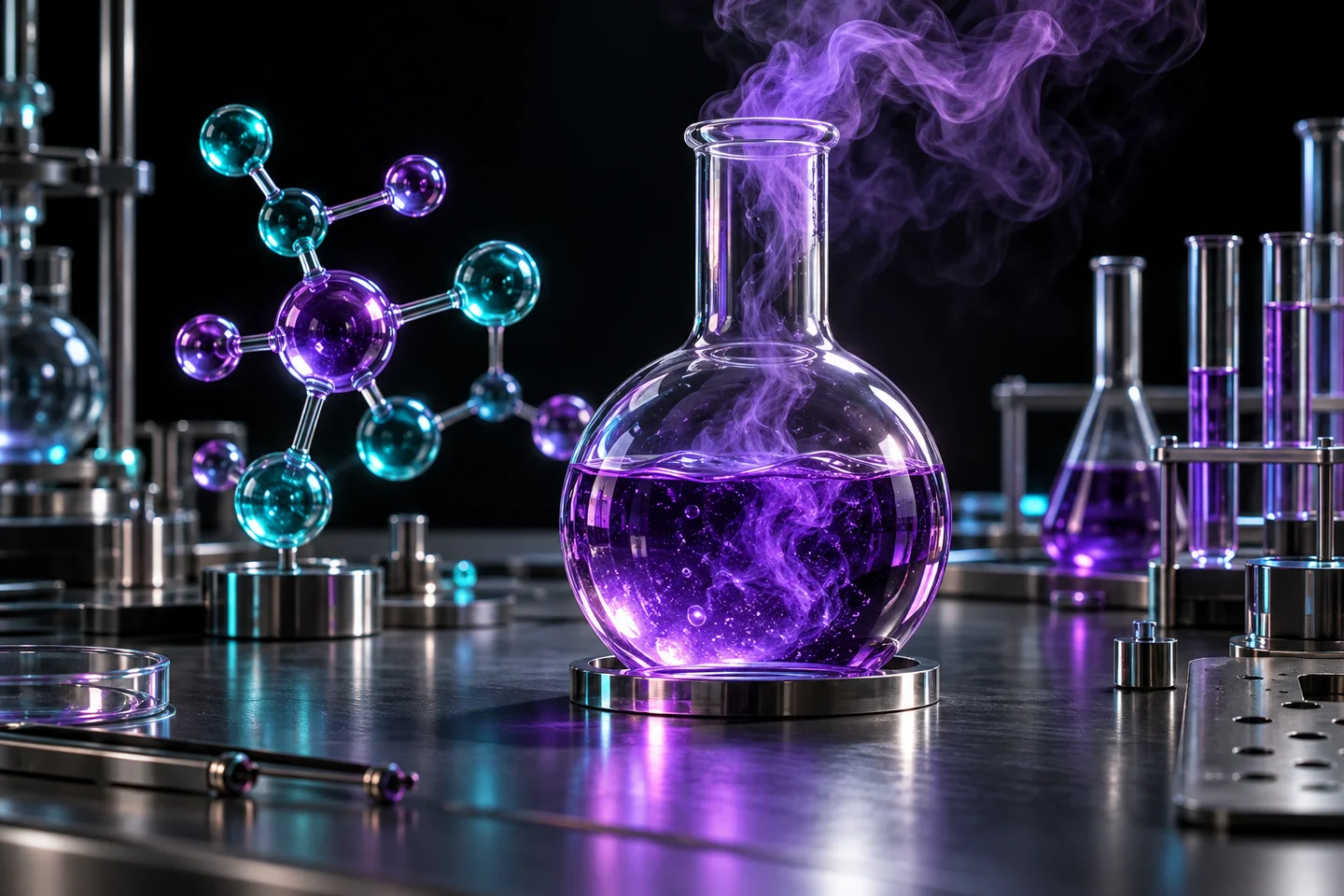
More than an experiment: a laboratory for your questions. A virtual chemistry world aiming to make elements, compounds and changing conditions explorable through scientific models.
Reactarium aims to make chemistry something you can explore rather than simply read about. Examine substances and compare temperature, pressure, concentration and quantity. Scientific accuracy and visual realism are goals; a completed simulation engine is not yet available.
The following systems are planned.
They are not publicly available yet.
A 3D workspace with beakers, Erlenmeyer flasks, test tubes, round-bottom flasks and pipettes. Balances, heating and cooling setups, stirrers, measuring instruments and safety equipment are planned.
The periodic table, elements, compounds and molecules. Molar mass, density, solubility, melting and boiling points, phases and safety information in a catalog supported by scientific references.
Stoichiometry, balanced equations, thermodynamics, kinetics, chemical equilibrium, acid–base behavior, precipitation, gas formation, solutions, mixtures and phase changes are within the research scope.
Mass, volume, moles, quantities in mg/g, concentration, temperature, pressure, pH and time. Parameters are intended to change results in scientifically meaningful ways.
Liquid behavior, color changes, gas, precipitates, evaporation and heat effects. Glass and metal materials with both molecular and macroscopic visualizations are planned.
Experiment history, measurement graphs, result reports, scientific explanations, uncertainty and error discussions, references, learning scenarios and laboratory safety education are planned.
Experience the idea.
This is separate from the actual product.
Assumes 25 °C, an ideal aqueous solution and one proton/hydroxide per unit. Activity coefficients and real substance properties are not modeled. Not a real experiment procedure. OpenStax — pH & pOH
The scientific foundation aims to make each model’s validity range, assumptions and uncertainty visible. There is no promise of exhaustive or perfectly accurate simulation of all reactions. Virtual experiments do not replace expert supervision or real laboratory safety training.
The project is in planning and scientific design. The educational preview on this page is not the planned laboratory engine.
It illustrates concentration, dilution and pH using selected ideal models. Assumptions are stated in the preview; it is not a real experiment procedure.